Freeze-Thaw Damage: Why Your Asphalt Gets Worse Every Winter (And What Actually Stops It)
QUICK ANSWER: Freeze-thaw damage happens when water works its way into small cracks or the base beneath your asphalt, then freezes and expands, prying the pavement apart from the inside. Each thaw lets more water in, so the cycle repeats and compounds every time temperatures swing back and forth across freezing. The surface damage you see — hairline cracks, edge crumbling, potholes, sunken patches — is almost always the visible end result of that repeated expansion happening out of sight, in the base and sub-base layers below. becomes the cleanest spot in the room. Skip a step and you're fishing a warm, glitchy TV off the mantel next winter.
If you've ever wondered why a driveway that looked fine in October has a spiderweb of cracks by March, this is why. It isn't the cold itself doing the damage. It's what happens every time the temperature crosses back and forth over 32°F.
What a Freeze-Thaw Cycle Actually Is
A freeze-thaw cycle sounds simple: temperatures drop below freezing, then rise back above it. But what happens to water during that swing is what makes it destructive to pavement.
Water that has worked its way into a crack, a joint, or the pore spaces of the base material doesn't just sit there when temperatures drop. As it turns to ice, it expands by roughly nine to ten percent in volume. Confined inside a crack or a compacted layer of aggregate, that expansion has nowhere to go, so it pushes outward against whatever's holding it in place. The pressure behind confined freezing water is enormous — plenty to widen a crack that started out barely visible.
When the ice melts again, the water doesn't disappear. It settles into the slightly larger space it just created, joined by any extra moisture that seeped in during the thaw. The next freeze repeats the whole process, only now the crack is wider and holds more water. That's the trap. Freeze-thaw damage rarely looks dramatic at first and then suddenly seems to speed up, because each cycle inherits a bigger opening than the last one left behind.
The Chain Reaction Beneath the Surface
Most people picture freeze-thaw damage as a surface problem, but the more consequential action happens below the asphalt, in the base and subgrade.
When ground temperatures drop and stay there, freezing can penetrate down through the pavement into the soil beneath it. If that soil holds moisture (and clay-heavy soils, common across much of West Michigan, hold onto water rather than draining it), ice doesn't just form randomly — it tends to organize into layers called ice lenses. These lenses grow by pulling additional moisture up from unfrozen soil below through a process engineers call cryosuction, thickening as the freeze continues. As they thicken, they physically lift the layers above them, including the asphalt. That upward movement is frost heave, and it's rarely uniform. Some sections of a driveway or lot lift more than others depending on soil composition and moisture content, which is exactly what creates the uneven, uneasy feeling of driving or walking over pavement that's been through a hard winter.
The reverse process is just as damaging. When a thaw arrives, it doesn't warm the ground evenly all at once — it works from the surface down. That means you can have a saturated, thawed layer sitting right on top of soil that's still frozen and impermeable. Water gets trapped in that upper layer with nowhere to drain, and the soil turns soft right at the moment traffic is driving over it.
This is why so much visible pavement failure shows up in early spring instead of the dead of winter. A sudden pothole, a section that gives way under a car — the subgrade is at its weakest exactly when the freeze finally lets go.
TIP: If you notice a section of pavement that feels slightly springy or soft underfoot during a spring thaw, that's worth flagging even if there's no visible crack yet. It's often an early signal of subgrade weakening that will show up as a structural crack or dip once the ground fully dries out and stabilizes.
Why Some Winters Are Harder on Asphalt Than Others
It's a common assumption that the coldest winters do the most damage to asphalt. In practice, the opposite is often true. A winter that stays reliably below freezing for weeks at a stretch keeps whatever moisture is present locked as stable ice — no expansion happening, no repeated cycling, no new water working its way in and out of cracks.
The winters that do real damage are the ones with constant back-and-forth: a warm afternoon that melts snow and lets water seep into pavement, followed by a hard freeze overnight that locks that water in place and expands it. Repeat that pattern a dozen times over a season and you've effectively run a dozen small hydraulic jacks under your pavement, each one slightly widening whatever weaknesses already existed. This is exactly the pattern that produces the worst pothole seasons in the Great Lakes region — not the deepest cold snaps, but the choppiest temperature swings, especially when they land on pavement that already has clay-heavy, poorly draining soil underneath it and heavy traffic loading it during the thaw.
Signs Freeze-Thaw Damage Is Already Underway
Because so much of the process happens beneath the surface, the visible signs often lag behind the actual damage. A few patterns are worth watching for on a driveway or lot you're responsible for:
- Hairline cracks that seem to lengthen or multiply after every winter, even if they were barely noticeable the year before. Each one is a potential water entry point that widens with every freeze cycle.
- Edges that crumble or separate first, particularly along a driveway's perimeter or where pavement meets a curb or landscaping bed. Edges lack the lateral support of pavement surrounded on all sides, so they take the brunt of expansion pressure.
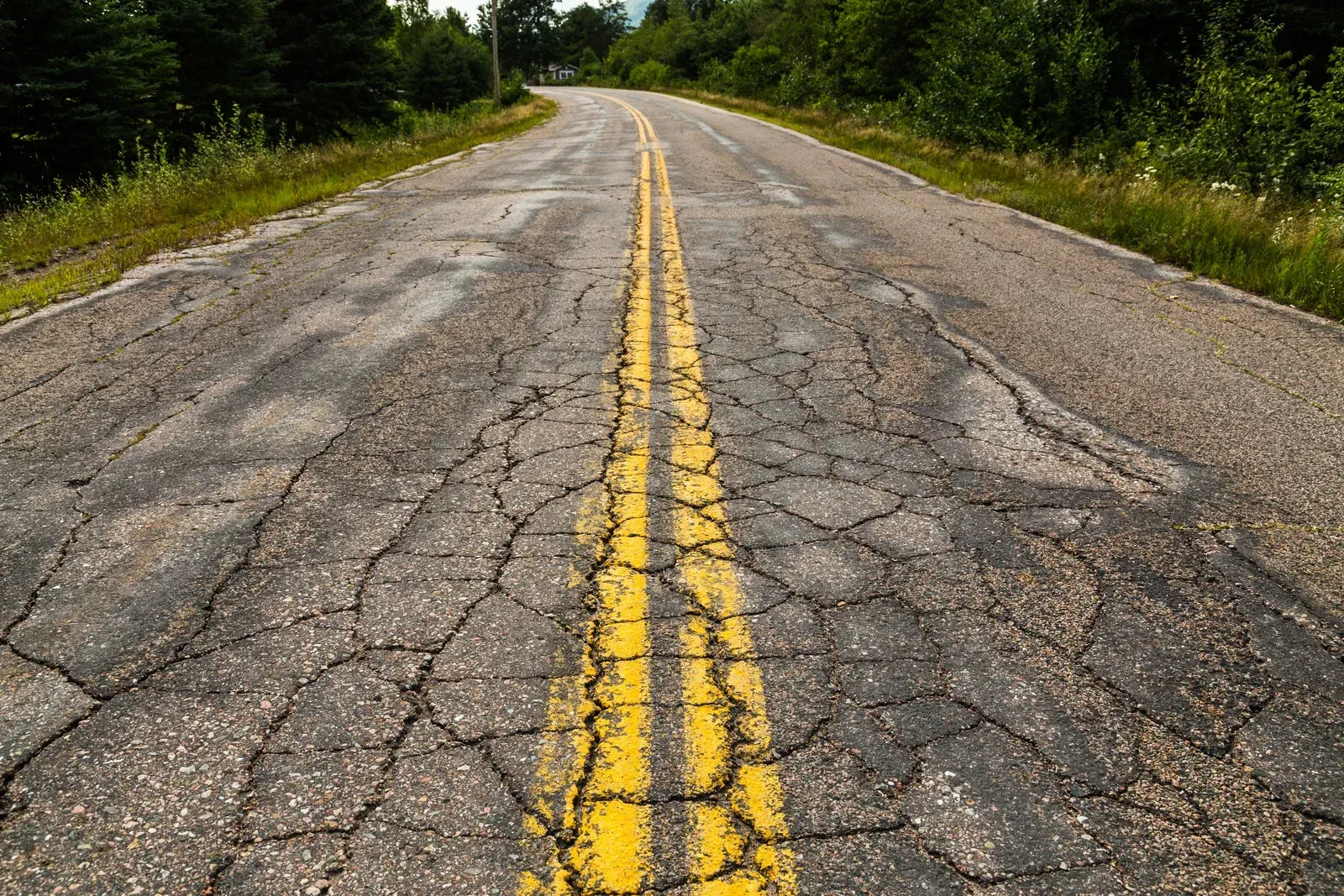
- Alligator-pattern cracking — a web of interconnected cracks resembling reptile scales — which signals that the base beneath the asphalt has already been compromised by repeated saturation and freeze cycles, not just the surface layer.
- Localized dips or soft spots that appear seasonally and sometimes seem to firm back up later in the year, which usually points to a subgrade that's cycling between saturated and dry rather than staying stable.
WARNING: Standing water that sits on a paved surface for more than a day after rain or snowmelt is one of the clearest indicators that freeze-thaw damage is accelerating, not stabilizing. Pooled water means poor drainage, and poor drainage means more moisture sitting exactly where it can seep into cracks and refreeze. Left unaddressed through another winter, a standing-water spot is one of the most reliable predictors of where the next pothole will form.
Driveways vs. Parking Lots: Why the Damage Pattern Differs
Freeze-thaw mechanics are the same everywhere, but how the damage shows up depends heavily on scale and traffic pattern. A residential driveway typically sees lighter, slower traffic concentrated in a couple of well-worn tire paths, so damage often starts as parallel cracking along those paths or edge deterioration where the driveway meets the garage apron or street.
Commercial parking lots and access drives deal with a different set of stresses. Heavier vehicles and constant stop-and-turn movement twist and shear the surface in ways a driveway rarely experiences. Larger paved areas also make it harder to keep drainage and grading consistent across the whole lot, and that gap is where freeze-thaw stress finds room to work unevenly.
Anyone who manages a commercial lot has probably watched this play out: one corner — often near a downspout or wherever the delivery trucks turn — falls apart years ahead of the rest of the surface, even though the whole lot went in on the same day. That uneven aging is usually a drainage and base story, not a paving-quality one.
What Actually Slows the Cycle Down
At its core, freeze-thaw damage is a water problem. The countermeasures that work best are the ones that keep water from reaching the base in the first place, and the ones that keep it moving off the surface once it lands there.
Sealcoating plays a role here by renewing the surface layer that resists water penetration, though it works best as ongoing maintenance rather than a fix for pavement that already has significant structural cracking. Crack sealing addresses the specific entry points where water gets in, and doing it before winter — closing up small cracks while they're still small — interrupts the cycle before it has a chance to widen them. Grading and drainage design matter just as much, if not more, because a surface that sheds water quickly simply gives freeze-thaw less material to work with in the first place. A driveway or lot that pools water even in mild weather is going to have a rough time every winter regardless of how well the asphalt itself was installed.
Base quality is the piece that's easiest to overlook because it's invisible once the project is finished, but it's often the biggest single factor in how well a surface tolerates repeated freeze-thaw stress over the years. A properly compacted, well-draining base resists the ice-lens formation that drives frost heave, while a base with poor drainage or inadequate compaction gives water places to collect and freeze, effectively guaranteeing heave and cracking on a shorter timeline no matter how well the surface asphalt is applied.
When It's Past the Point of Patching
Small cracks caught early respond well to crack sealing and routine maintenance. But once freeze-thaw cycling has reached the base — visible through alligator cracking, persistent soft spots, or sections that heave and settle year after year — surface patches tend to fail again quickly because they're being laid over a foundation that's still moving. At that point, the more durable fix usually involves addressing the base itself, whether through targeted excavation and rebuilding of the affected area or a full resurfacing that restores proper grading and compaction from the ground up. Treating only the symptom on top of a compromised base tends to buy a season, not a solution.
Frequently Asked Questions
Does a mild winter mean less freeze-thaw damage?
Not necessarily. What matters more than overall temperature is how often the pavement crosses back and forth over the freezing point. A mild winter with frequent thaw-and-refreeze swings can do more cumulative damage than a colder winter that stays consistently frozen.
Can freeze-thaw damage happen in a single season?
It's possible on pavement that already has existing cracks, poor drainage, or a weak base, since those conditions give water an immediate path in. On pavement in good condition, freeze-thaw effects usually build gradually over several seasons before becoming visible.
Is freeze-thaw damage worse on older asphalt?
Generally, yes, because older asphalt has had more time to develop the small surface cracks that let water in, and the binder itself becomes more brittle with age and UV exposure, making it more prone to cracking under the stress of expansion.
Does salt used for de-icing make freeze-thaw damage worse?
Repeated exposure to de-icing salt can accelerate surface wear and interact with existing cracks, though the freeze-thaw expansion of water itself remains the primary mechanical driver of the damage.
Protecting Pavement Means Understanding What Freeze-Thaw Really Does
Freeze-thaw damage isn't a single event but an accumulation, each cycle widening what came before it until small cracks become structural problems. Water finds its way into pavement long before anyone notices a problem, and the freezing and thawing that follows does the real work of prying that pavement apart from the inside. Understanding this process is what truly separates reactive patching from maintenance that actually holds up over time, because timing matters just as much as the repair itself.
The pattern is consistent across driveways and parking lots alike: damage that starts small in the base rarely stays contained to one season, which is why catching it early changes the outcome so much. Hot Mix Paving MI, based in Grand Rapids, has spent 20+ years watching how pavement responds to these swings, and that experience shapes how problems get diagnosed rather than patched. Pavement that's properly graded, sealed, and built on a solid base always weathers these cycles better.